


Are you about to pick a Certified Development Company the same way most first-time borrowers do by picking whoever responds first?
If yes, you may be setting yourself up for delays, extra costs, and a frustrating lending experience that lasts 20 to 25 years.
The SBA 504 loan is one of the most powerful financing tools available to U.S. small business owners. According to the SBA, the average 504 loan approved in FY2024 was $1.1 million. That is not a small commitment. And yet, many first-time borrowers treat CDC selection as an afterthought.
This post is for business owners who are serious about getting their SBA CDC 504 loan right the first time.
What Is a CDC and Why Does Your Choice Matter?
A Certified Development Company (CDC) is a nonprofit, SBA-regulated organization that administers the 504 loan on behalf of the SBA. According to the SBA, CDCs are the community-based partners that make the 504 program work at the ground level.
Here is how a standard SBA 504 deal is structured:
-
50% — First mortgage from your bank or credit union
-
40% — CDC loan (the SBA 504 portion), up to $5.5 million
-
10% — Your equity injection as the borrower
Your CDC holds the 40% second lien. They process your application, coordinate with the SBA, work with your bank, manage your closing, and then service your loan for its full term up to 25 years.
That is a long relationship. Choosing the wrong CDC for SBA 504 loan is not just an inconvenience. It can cost you time, money, and peace of mind for decades.
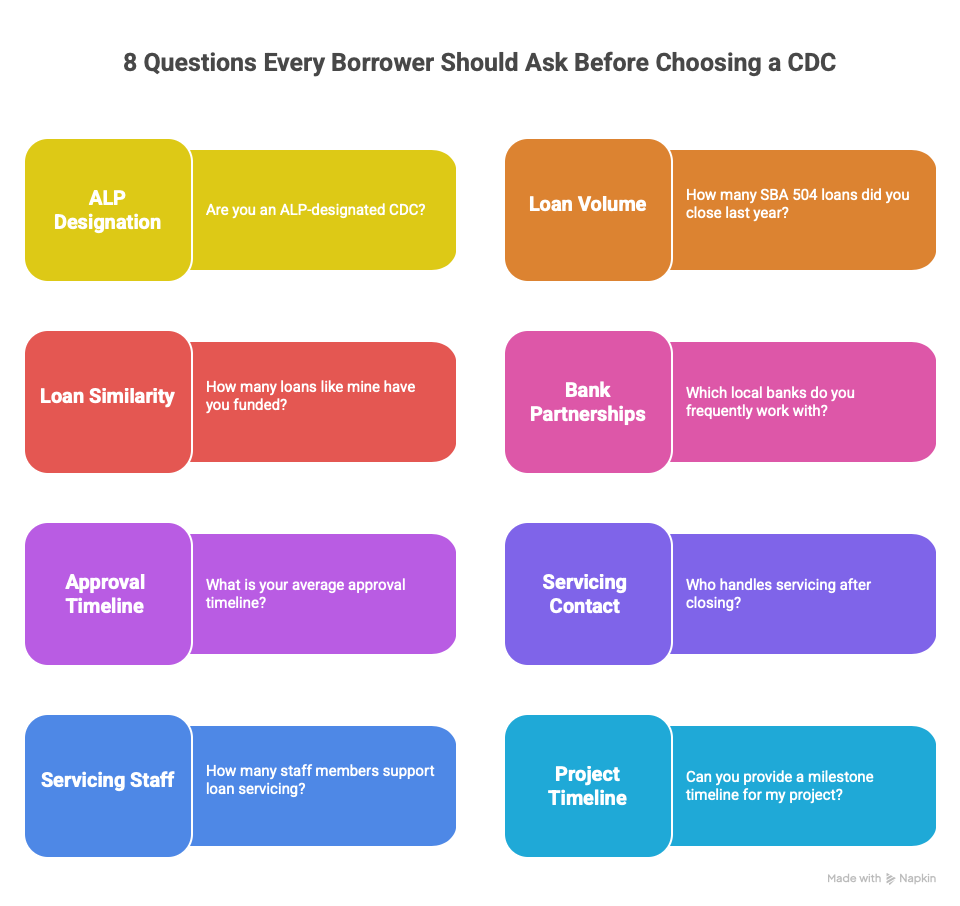
The 6 CDC Selection Mistakes That Cost First-Time SBA 504 Borrowers the Most
Most first-time borrowers approach CDC selection without a framework. They compare two or three names, pick whoever calls back first, and assume the rest of the process takes care of itself. It does not.
The SBA 504 lending process involves a three-party structure, a multi-month timeline, and a servicing relationship that can last 25 years. The CDC you choose sits at the center of all of it. Getting this decision wrong does not just slow down your loan. It can affect your rate lock, your closing timeline, your compliance standing, and how smoothly your loan is managed long after you sign.
Below are the six SBA 504 loan mistakes that come up most often with first-time borrowers and what each one actually costs you in practice.
Mistake 1: Choosing Based on the Fee Quote Alone
This is the most common mistake in CDC SBA loan selection, and it is easy to understand why. Borrowers see a slightly lower processing fee and assume they are getting a better deal.
Here is the truth: SBA 504 interest rates are not set by your CDC. They are set at the time of debenture funding based on market conditions and they are the same nationwide for any given funding cycle.
The real cost difference between CDCs for Small Business Finance comes from:
-
How long the process takes (delayed closings can kill a real estate deal)
-
Errors in document preparation that trigger SBA revision requests
-
Servicing quality over a 25-year loan term (modification fees, assumption handling, prepayment processing)
Quick Fact: A processing delay of just 30 to 60 days can result in a missed purchase opportunity or a higher bank rate lock cost far exceeding any fee savings from a cheaper CDC.
Over a 25-year fixed loan, operational efficiency matters far more than the fee quote you received on day one.
Mistake 2: Ignoring Geographic Fit and Local Knowledge
Not every CDC that says it serves your state is equally experienced in your specific market. A CDC headquartered 800 miles away may technically be licensed in your state but have no relationships with local banks, no familiarity with your county's permit and appraisal timelines, and no track record in your industry.
SBA 504 loan processing requires close coordination between the CDC, the first-mortgage lender, and the SBA processing center. CDCs that work regularly with banks in your local market move faster and encounter fewer friction points.
Tip: Ask any CDC you consider: "Which banks in our area have you closed deals with in the last 12 months?" If they cannot name at least two or three local lenders, that is a signal worth taking seriously.
Mistake 3: Not Checking the CDC-Bank Pairing
The SBA 504 lending process is a three-party transaction. Your CDC does not work alone. They coordinate directly with your first-mortgage lender throughout underwriting, closing, and funding.
A CDC that has established relationships with the banks active in your market will:
-
Communicate more efficiently with the lender
-
Anticipate document requirements from both sides
-
Reduce back-and-forth that delays your closing
First-time borrowers often arrive with a bank already in mind and then pick a CDC separately without ever asking whether those two parties have worked together before. This is a structural mistake.
What to ask in the first 15 minutes of an exploratory call:
-
Have you worked with [your bank] before on a 504 deal?
-
What is your average time from completed application to SBA approval?
-
How many loans similar to mine (size, industry, property type) have you closed in the last three years?
Mistake 4: Overlooking Post-Closing Servicing Quality
The closing is not the end of the relationship. It is the beginning of a 20 or 25-year loan servicing arrangement.
Here is what post-closing servicing actually involves:
-
Processing monthly ACH payments through the Central Servicing Agent
-
Handling modification requests if your business circumstances change
-
Managing assumption requests if you sell the property
-
Processing prepayment calculations correctly
A CDC with thin staff, high employee turnover, or weak document management will create friction at every one of these touchpoints. Ask directly: "Who handles servicing after closing, and how many people are on that team?"
Mistake 5: Not Treating ALP Status as a Minimum Filter
The Accredited Lenders Program (ALP) is a formal SBA designation. It means the CDC has earned increased authority to process, close, and service 504 loans, and SBA relies on the CDC's own credit analysis when making approval decisions.
To earn ALP status, a CDC must:
-
Have approved at least 20 SBA 504 loan applications in the last three years
-
Maintain a portfolio of at least 30 active 504 loans
-
Have loan officers with a minimum of three years of 504-specific experience
-
Demonstrate a record of compliance with SBA underwriting and servicing standards
Only approximately one-third of CDCs hold ALP designation.
What ALP status means for you as a borrower:
-
Faster processing and approvals
-
A CDC with a verified track record, not just a license
-
Reduced risk of mid-process errors that require SBA intervention
If a CDC cannot confirm ALP status, treat that as a meaningful data point. It does not disqualify them but it raises the bar for what else they need to demonstrate.
Mistake 6: Missing the Red Flags in the First Call
Experienced borrowers learn to read the signals early. Here are the red flags to watch for before you commit to a CDC:
-
They cannot tell you how many deals they have closed in your industry in the last two years
-
They take more than 48 hours to return your initial inquiry
-
They cannot explain the three-party structure (bank, CDC, SBA) clearly without jargon
-
Their document request list arrives incomplete or disorganized
-
They have no formal written timeline or milestone checklist for your loan
Pro Tip: A good CDC will proactively ask about your bank relationship, your property type, your occupancy percentage, and your business's net income history — all in the first conversation. If they do not ask these questions, they are not yet doing their job.
Key Takeaways
-
SBA 504 interest rates are uniform nationwide — your CDC choice does not change your rate, but it does change your experience
-
ALP designation is a reliable, SBA-verified signal of CDC quality — roughly two-thirds of CDCs do not hold it
-
CDC-bank pairing is a structural factor most first-time borrowers ignore entirely
-
Post-closing servicing quality is a 20 to 25-year reality — evaluate it before you sign
-
The first 15-minute call with any CDC should include specific, direct questions — not just introductions
Conclusion
Picking a CDC for business loans is one of the highest-leverage decisions in your entire SBA 504 loan process. Most first-time borrowers spend more time choosing office furniture than they do evaluating the organization that will manage their $1 million loan for the next quarter century.
The mistakes outlined here are common. They are also avoidable. The borrowers who get the best outcomes are the ones who treat SBA 504 loan CDC selection like the strategic business decision it is, asking hard questions early, verifying credentials, and choosing based on track record rather than the fastest email response.
504 Capital Corporation is proud to offer its services in Virginia, North Carolina, and Maryland. As the #1 CDC in SBA's Virginia District and a holder of the Accredited Lenders Program (ALP) designation, 504 Capital brings deep regional knowledge, established banking relationships, and a proven compliance record to every transaction. Whether you are in Chesapeake, Raleigh, or Silver Spring, the team at 504 Capital is equipped to move your deal forward, accurately and efficiently.
Frequently Asked Questions
1. Can I switch CDCs after my SBA 504 loan application has already started?
Yes, it is technically possible to change CDCs before your loan closes, but it resets significant portions of your paperwork and timeline. SBA requires a new application submission from the new CDC. This can delay your closing by weeks or months. The earlier you identify the right CDC, the lower the risk of a disruptive mid-process switch.
2. Does every state have CDCs available, or are some areas underserved?
The SBA maintains a directory of CDCs authorized to operate in each state. Most major metropolitan and suburban markets have multiple active CDCs. However, rural areas may have fewer options, and the depth of experience among available CDCs varies widely. Geographic coverage on paper does not always reflect active deal volume in a specific county or market.
3. How does SBA score or rank CDCs, and is that information public?
SBA evaluates CDCs through periodic reviews and assigns ratings such as "Acceptable" or "Acceptable With Corrective Actions Required." CDCs must hold a current acceptable rating to maintain ALP status. These review assessments are not published in a public-facing consumer database, but borrowers can and should ask any CDC directly about their current SBA review status.
4. What happens to my SBA 504 loan servicing if my CDC closes or loses its SBA authorization?
If a CDC loses SBA authorization, the SBA can transfer your existing loan to another approved servicer. This protects borrowers from loss of service. However, transitions can create short-term administrative disruptions. Choosing a financially stable, well-established CDC reduces this risk considerably.
5. Is there a difference between how CDCs handle construction loans versus standard real estate purchase loans?
Yes. Construction loans under the SBA 504 program involve interim financing, phased draws, and coordination with builders — all of which require more active CDC management than a standard purchase. Not all CDCs have equal experience with construction loan structures. If your project involves renovation or ground-up construction, ask specifically how many construction-phase 504 loans the CDC has managed in the last three years.
Ready to Work With a CDC That Gets It Right the First Time?
If you are evaluating your options for an SBA CDC 504 loan in Virginia, Maryland, or North Carolina, talk to a specialist who can walk you through the process without the guesswork.
Call 504 Capital Corporation at (757) 623-2691 or Contact Us to start your conversation today.

You must be logged in to post a comment.