

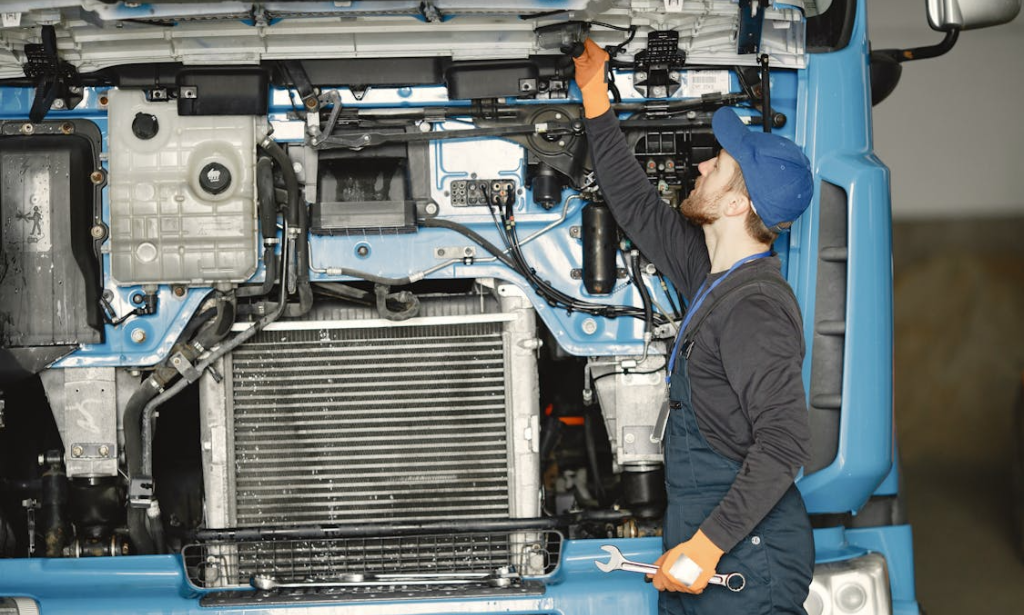
In most repair facilities, safety discussions usually center around equipment ratings, procedures, and compliance rules. But one of the most overlooked contributors to accidents isn’t a machine failure or missing protocol — it’s the human body under strain.
Technicians in dump truck repair shops spend long hours working in physically demanding positions: bending under raised beds, reaching across wide frames, and handling heavy components repeatedly throughout the day. Over time, that strain builds up. And when fatigue sets in, precision drops, reaction time slows, and small mistakes start to slip through.
Ergonomics is what bridges that gap between demanding work and sustainable safety.
When the Body Becomes the Weak Point
In many shops, the layout and workflow are designed around machines — not people. That means technicians often adapt to uncomfortable positions just to complete a task.
Think about a simple maintenance job on a dump truck:
· A technician working under a raised bed that isn’t properly stabilized
· Tools placed just far enough away to require repeated stretching
· Repetitive lifting of heavy components without mechanical assistance
None of these seems extreme on their own, but together they create a cycle of fatigue. And fatigue is where safety starts to break down.
This is often where improper setups or unstable supports create additional risk — especially when teams are not consistently using certified truck safety equipment.
Small Strain Today, Bigger Problems Tomorrow
Ergonomic issues don’t usually cause immediate accidents. They build quietly over time.
A technician may start the day sharp, but after hours of awkward movement and physical strain, attention naturally drops. That’s when mistakes happen — like misplacing a support, rushing through a check, or overlooking a critical safety step.
In dump truck environments, those small errors can become serious fast. A raised bed without proper dump bed safety support doesn’t leave room for correction once something goes wrong.
What makes ergonomics so important is that it addresses the cause before the error even occurs.
Designing Work Around People, Not Pressure
A safer shop isn’t just about adding more rules — it’s about reducing unnecessary effort.
Simple changes in workflow can dramatically reduce fatigue:
· Positioning vehicles so technicians don’t overreach
· Keeping essential tools within natural arm range
· Reducing repeated lifting through proper equipment use
· Ensuring stable support systems are always pre-installed
This is where consistent use of truck repair safety equipment plays a quiet but critical role. When systems are designed to reduce physical strain, technicians don’t have to compensate with extra effort or risky shortcuts.
How Equipment and Ergonomics Work Together
Ergonomics and safety equipment are often treated as separate topics, but in practice, they work together.
A well-designed system of truck bed locks, for example, doesn’t just secure a raised dump bed — it reduces the need for constant checking, repositioning, or manual adjustment. That means less physical strain and fewer interruptions during work.
Similarly, reliable dump truck bed safety stands eliminate unstable positioning that forces technicians into uncomfortable angles just to “double-check” stability.
When equipment is easy to use and physically supportive, technicians naturally work in safer positions without even thinking about it.
Reducing Fatigue Is Reducing Risk
One of the most direct benefits of ergonomic improvement is reduced fatigue. And reduced fatigue means better judgment.
A technician who isn’t constantly adjusting posture or straining under awkward conditions is more likely to:
· Follow safety procedures correctly
· Double-check equipment placement
· Communicate clearly with team members
· Avoid rushed decisions
In other words, ergonomics doesn’t just protect the body — it protects decision-making.
Where BedLock Safety Products Fits In
BedLock Safety Products LLC supports this approach by designing engineered truck bed locks that are not only strong but practical to use in real working conditions.
Their systems are built to provide stable dump bed safety support without requiring excessive force, complicated setup, or repeated adjustment. That simplicity matters in busy repair environments where technicians are already managing physical workload and time pressure.
Models like the BL-400 A/B and BL-450 A/B are commonly used for routine maintenance because they reduce setup effort while maintaining consistent safety performance. For heavier operations, the BL-600 A/B through BL-800 A/B systems provide stronger stabilization without adding unnecessary complexity to the workflow.
Even specialized options like the BLN-450 A/B Notched BedLock are designed with real shop constraints in mind, allowing technicians to work safely in tighter or modified frame conditions without added strain.
The result is equipment that supports both safety and physical ease of use.
When paired with dependable truck bed locks and properly integrated dump bed safety support, it creates a work environment where technicians aren’t just protected — they’re set up to succeed physically and operationally.
Visit their website or contact them for details.
Author Bio
Daniel Brooks is a workplace safety and industrial content writer specializing in fleet operations, equipment design, and technician wellbeing. With a background in technical writing for the automotive and heavy equipment industries, he focuses on making safety concepts practical and easy to apply in real shop environments. Outside of writing, Daniel enjoys woodworking, restoring old tools, and exploring mechanical design projects.

You must be logged in to post a comment.